Building Smarter Systems is no longer a trend but a necessity. Artificial Intelligence (AI) is transforming industries by automating processes, improving decision-making, and bringing in new efficiencies. Finance to healthcare, retail to logistics, AI-driven solutions are paving the way to smarter innovations. So how do you move from the idea of AI to an actual model? Understanding the steps, tools, and techniques in Building Smarter Systems is the secret to being capable of leveraging the true potential of AI.
Getting to Know the Fundamentals of AI Models
Every journey in Building Smarter Systems begins with a solid understanding of what an AI model is. Simply put, an AI model is a mathmatical system trained on data to perform prediction, classification, or automation tasks. AI models rely on machine learning algorithms that improve with more data and feedback. For businesses, the question remains: How can AI models be applied to drive measurable outcomes?
Starting with the basics enables businesses to translate their goals to the possibilities of AI.
Defining the Problem Before the Solution
One of the biggest mistakes in leveraging Building Smarter Systems is jumping to implement technology before the problem is clearly defined. Businesses must ask, prior to choosing a tool or methodology: What exactly do we want AI to solve? Whether reducing customers’ wait times, detecting fraud, or forecasting demand, the issue must be clearly defined. Defining the issue prevents the AI model from being merely smart but not beneficial.
Data: The Lifeblood of Building Smarter Systems In Building Smarter Systems, data is the most valuable asset. High-quality and relevant data is essential to the success of even the most advanced algorithms. Sourcing, cleansing, and preparing data is often the most time-consuming yet vital exercise in AI development. Numbers and other structured data, as well as unstructured data like text, images, and videos, are used to train models.
The question that organizations should ask is: Do we have enough data, and is it relevant to the problem we’re attempting to fix?
This factor guides the entire AI-building process.
Choosing the Right Tools and Frameworks
The tools and frameworks you select are the keys to Building Smarter Systems. Open-source platforms such as TensorFlow, PyTorch, and Scikit-learn provide good environments to build models. Cloud platforms such as AWS AI, Microsoft Azure AI, and Google AI provide ease of deployment with scalability in consideration. Every tool has its specialty depending on whether you are building for natural language processing, computer vision, or predictive analytics. The right framework selection ensures efficiency and reliability when building an AI model.
Developing Successful AI Model Development Methods
The techniques applied in Constructing Smarter Systems typically make or break the project’s success. Techniques such as supervised learning, unsupervised learning, reinforcement learning, and deep learning each have their particular applications. For example, supervised learning is excellent for fraud detection, while reinforcement learning is ideal for robotics and automation. Understanding these techniques allows businesses to choose the best technique for their problem.
Training and Testing the Model
Following data preparation and technique selection, the next step in Building Smarter Systems is model training. This involves feeding the data into the chosen algorithm to allow the AI to discover patterns. Training alone is not enough, however—testing the model with unseen data ensures the accuracy and reliability of the model. AI models can become biased or produce unreliable results if not tested appropriately. That is why testing and iteration on a regular basis are not an option when creating AI.
Deployment and Integration into Real Systems
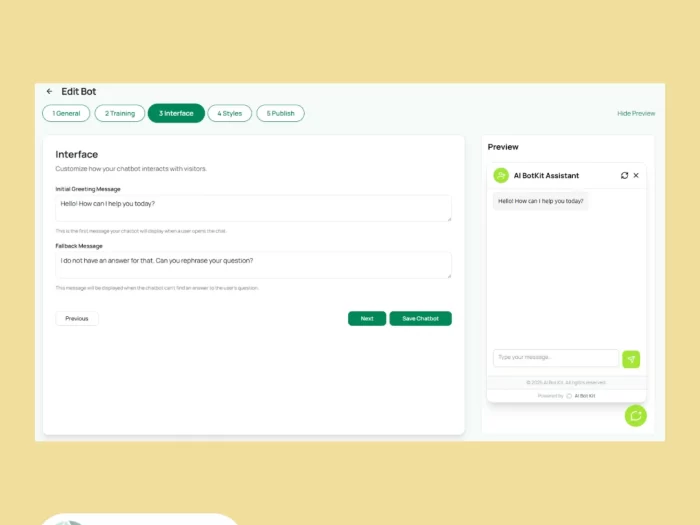
Deployment is where the value of Building Smarter Systems is actualized. Regardless of the complexity of an AI model, it is only useful when deployed into day-to-day workflows. Whether it’s a chatbot on a website, a fraud detection solution in banking, or a recommendation engine in e-commerce, deployment must be seamless. Integration with legacy IT systems is typically complex, yet it is required to ensure usability and adoption by end-users.
Model Optimization and Continuous Learning
AI does not stop learning when it is deployed. Continuous enhancement is the essence of Building Smarter Systems. As new data arises, the AI model must be retrained and tuned to maintain accuracy. Businesses must establish a process of monitoring, feedback, and optimization. The question to consider is: Are we updating our AI systems frequently enough to keep ahead of changing circumstances? Regular optimization ensures long-term success.
Ethical Considerations in AI Development
No discussion on Building Smarter Systems is complete without a mention of ethics. Data privacy, bias, and transparency are a few concerns that must be top of mind. Businesses developing AI models must deliver fairness, accountability, and compliance with laws and regulations. By deploying ethical frameworks, organizations not only build smarter systems but also win the trust of their customers and clients.
The Role of Human Expertise in AI Systems
Despite the advent of AI, human expertise plays a key role in Building Smarter Systems. AI automates tasks, yet humans provide context, direction, and judgment. The collaboration between data scientists, engineers, and subject matter experts ensures AI solutions continue to align with real-world needs. In fact, the most insightful systems are those where human creativity and AI intelligence complement each other.
Conclusion: Partner with Lead Web Praxis
Building Smarter Systems is a stepwise process demanding problem clarity, good data, the right tools, established techniques, and ongoing optimization. Each stage, from training models to deployment to ongoing improvement, is vital. The future belongs to those organizations that responsibly and strategically deploy AI. At Lead Web Praxis, we specialize in guiding businesses through this process, transforming ideas into intelligent AI-driven solutions. If your business is ready to step into the future and start Building Smarter Systems, contact Lead Web Praxis today. Let’s build smarter, scalable, and efficient systems that work for you.